April 2, 2026
What AI Tells Potential Clients About Top US Compliance Consultancies and Why It Matters
Before a compliance firm ever receives an inquiry, a decision is already being shaped.
A potential client opens ChatGPT, Gemini, or Perplexity and asks a question. Sometimes it is direct. Is this firm reputable. Sometimes it is comparative. Which compliance consultancy should I hire.
An answer comes back instantly. Confidently. Without the firm ever knowing the conversation took place.
This is now the first layer of due diligence.
It happens before the website visit. Before the introduction call. Before the shortlist is even formed.
This is the new front door of professional services. Most firms are not controlling what is being said about them behind it.
The Audit
We analyzed how four US compliance consultancies are represented across major AI platforms. ACA Compliance Group, Oyster Consulting, Red Oak Compliance Solutions, and HighCamp Compliance.
Across ChatGPT, Gemini, Claude, and Perplexity, we asked five consistent questions. Who they are. Whether they are reputable. What clients say. How they compare. And whether they should be hired.
The goal was not to validate accuracy alone. It was to understand how these systems construct a narrative and how that narrative influences a hiring decision.
What emerged was not random. It followed clear patterns. And those patterns have direct commercial consequences.
ACA Compliance Group: Strong Presence With a Structural Risk
ACA is one of the most established names in the compliance space. Across all platforms, the representation is detailed and confident. Their services are consistently described across regulatory compliance, risk management, cybersecurity, financial crime, and ESG advisory.
On the surface, this looks strong.
But there is a vulnerability that does not appear in traditional marketing analysis.
A separate, unrelated business operates under the name ACA Group in the consumer legal space, particularly around timeshare cancellations. That category generates large volumes of negative public sentiment and complaint-driven content.
AI systems do not separate intent. They aggregate signals.
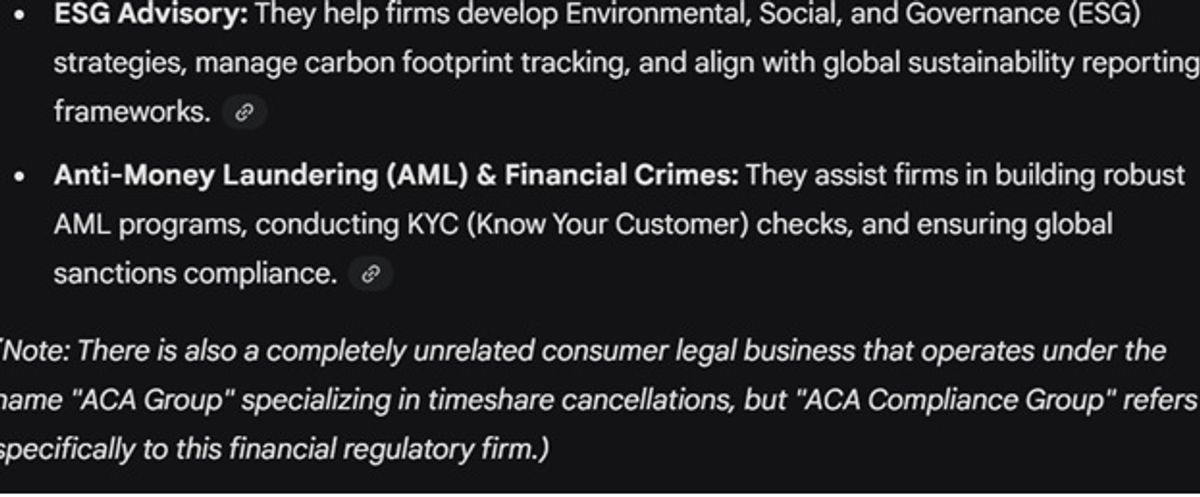
Gemini flagging name overlap between ACA Compliance Group and an unrelated consumer legal firm, April 2026.
When two entities share naming overlap, those signals can blend. The result is not always visible, but it is influential. A prospect researching ACA may receive a narrative that is partially shaped by an unrelated entity.
For a firm that sells credibility in regulated environments, even a small degree of narrative contamination introduces doubt at precisely the moment credibility is being evaluated.
Strong presence does not guarantee clean representation. Entity clarity must be actively reinforced.
Oyster Consulting: Positive Reputation With Invisible Loss
Oyster is represented accurately across platforms. The narrative is consistent. Practitioner-led. Former regulators. Strong in outsourced CCO services and ongoing advisory work.
Reputation signals are positive. Language around expertise and delivery appears frequently.
But the most important moment is not identity or reputation.
It is recommendation.
When given the profile of a typical buyer, a private fund seeking ongoing advisory at a mid-range budget, Claude's verdict was measured.
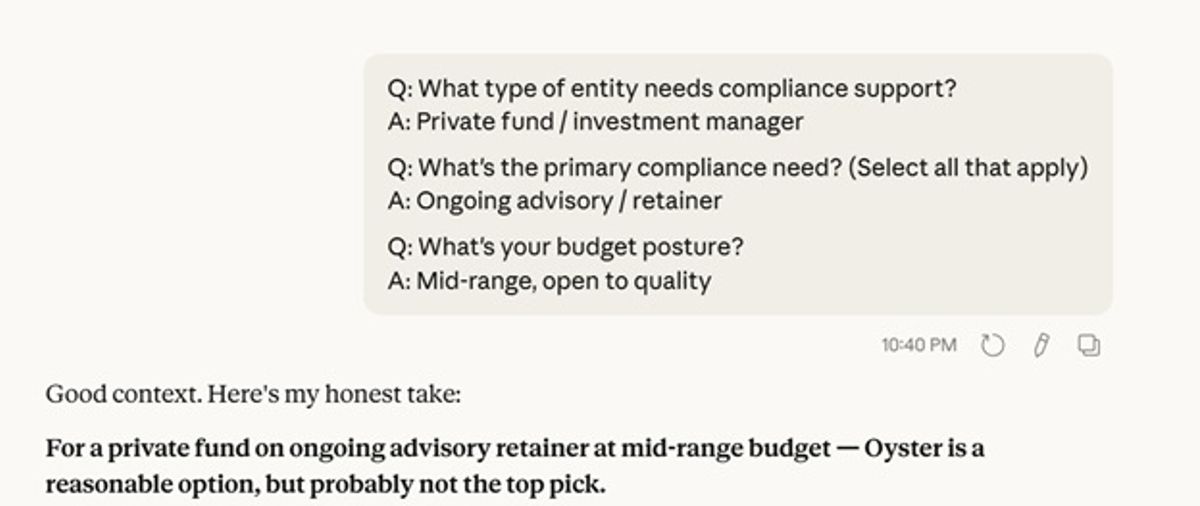
Claude's response when given the profile of a private fund seeking an ongoing compliance retainer, April 2026.
A reasonable option, but not consistently positioned as the strongest recommendation. Alternatives are suggested.
This is where AI moves from description to decision influence.
There is no visible drop in performance. No analytics signal. No missed inbound lead.
The prospect is simply redirected before contact is made.
You do not need a weak reputation to lose deals. You only need to not be the strongest recommendation.
Red Oak Compliance Solutions: When Category Defines Outcome
Red Oak presents the clearest case in the entire audit.
Despite being a legitimate and recognized business, AI systems consistently classify Red Oak as a compliance software provider rather than a consultancy.
When asked whether they should be hired for advisory work, the response is direct.
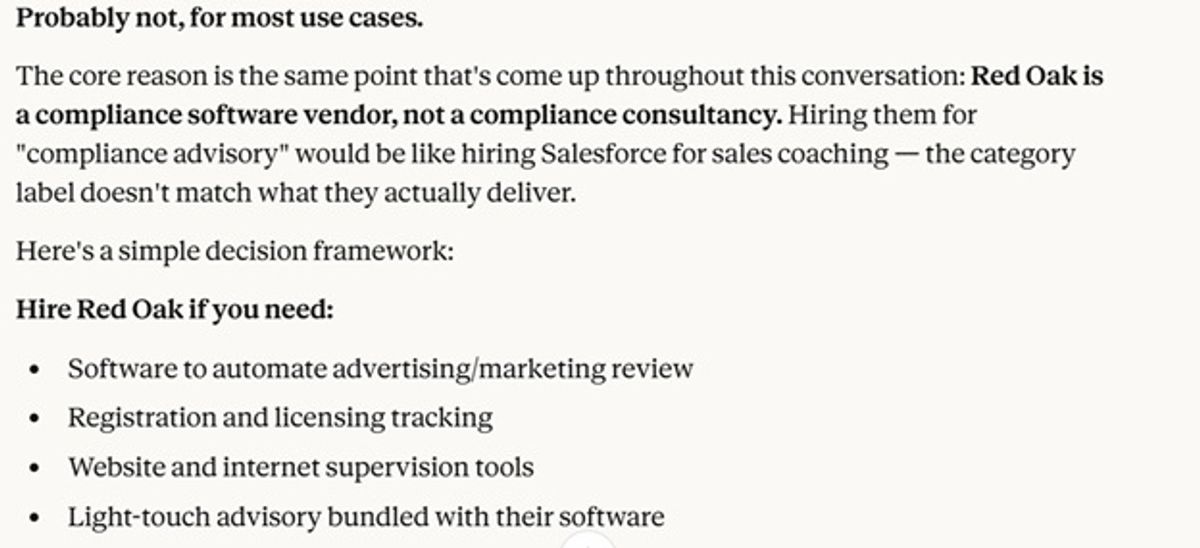
Claude's response when asked whether to hire Red Oak Compliance Solutions for advisory work, April 2026.
This is not a messaging issue in the traditional sense. It is a structural categorization issue.
AI systems determine which firms are relevant based on dominant signals across the web. In Red Oak's case, those signals point toward technology. As a result, the firm is excluded from advisory consideration before the evaluation process even begins.
The gap between how a firm sees itself and how AI systems classify it is not subtle. It is decisive.
This is not a positioning nuance. It is a structural exclusion from advisory conversations.
If your category is unclear, you are not competing. You are filtered out.
HighCamp Compliance: Precision Wins, But Proof Still Matters
HighCamp is the smallest firm in this group, but its representation is the most precise.
AI systems consistently describe it as a specialist firm focused on alternative investment managers, supported by former SEC examiner expertise. The positioning is clear and consistent across platforms.
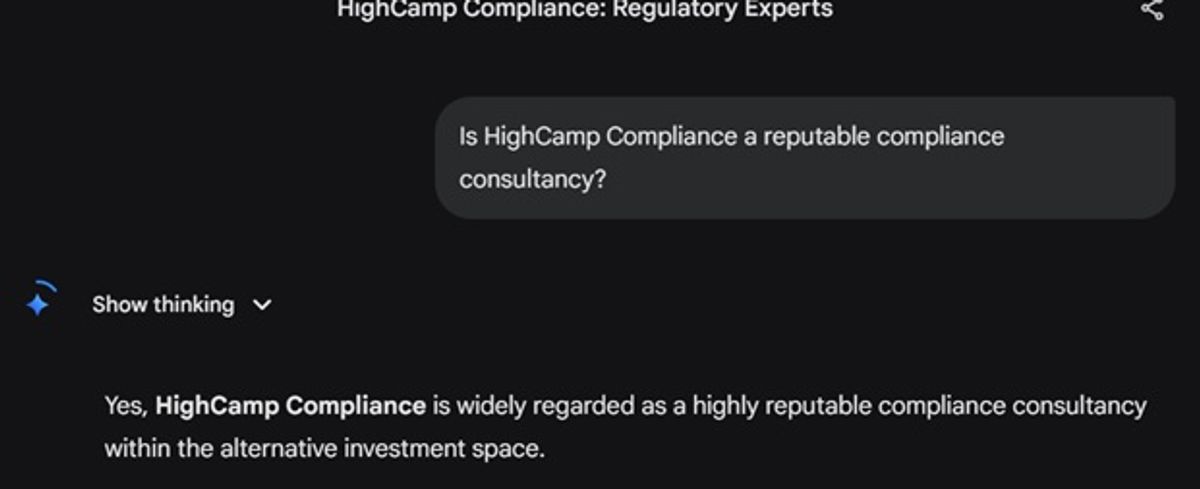
Gemini's response when asked whether HighCamp Compliance is a reputable consultancy, April 2026.
When asked whether to hire HighCamp, the response is equally clear. A strong fit for firms that value high-touch service and regulator-level insight.
This is what happens when signals are aligned.
At the same time, a limitation appears across multiple responses. A relatively small footprint of third-party validation. Limited reviews. Fewer external credibility signals.
Clear positioning gets you into the conversation. External validation strengthens your position within it.
The Pattern Behind the Responses
Looking across all four firms, the same structural dynamics appear.
Entity clarity is not guaranteed, even for established firms. If the identity of a business is not consistently reinforced across the web, AI systems will fill the gaps using whatever signals are available.
Category identity determines which conversations a firm enters. AI systems do not explore. They classify. And that classification determines who gets considered and who gets ignored.
Most importantly, AI systems are already making hiring recommendations. In every decision-oriented query, a clear answer was given. Sometimes supportive. Sometimes neutral. Sometimes redirecting. Always decisive.
These recommendations are happening before any direct interaction with the firm.
What This Means
The firms in this audit are credible and experienced. The gaps identified are not failures of capability.
They are failures of alignment between how the firm exists and how it is interpreted.
AI systems construct narratives from distributed signals. Content, mentions, reviews, structure, and consistency all contribute. When those signals are fragmented or unclear, the resulting narrative is shaped accordingly.
That narrative now sits at the beginning of the buying journey.
Not after engagement. Before it.
The Shift Most Firms Are Missing
AI is no longer just answering questions.
It is filtering options.
It is shaping perception.
It is influencing shortlists.
It is guiding decisions.
All before a prospect visits a website or speaks to a representative.
This is not an extension of marketing. It is a layer that sits above it.
And it is already active.
The risk is not visible.
There is no alert, no signal, no lost lead you can trace.
The decision simply moves elsewhere.
The Bottom Line
If you are not actively shaping how AI systems interpret and represent your firm, you are operating inside a system you do not control.
Your category may be misassigned.
Your credibility may be diluted.
Your competitors may be recommended instead.
And you will never see the moment it happened.
The firms that recognize this shift early will build an advantage that compounds quietly.
The ones that do not will continue to lose opportunities they cannot track or explain.
What Comes Next
At Ronites, we focus on how professional services firms are interpreted by AI systems during the buyer validation phase.
We call this a Digital Trust Diagnostic.
It answers one critical question.
What is AI actually saying about your firm when a serious prospect evaluates you.
Because whether you are shaping that narrative or not, it already exists.
And it is already influencing decisions.
Take the Next Step